
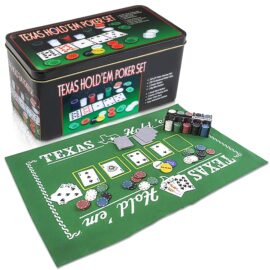

Texas Hold’em Poker: Understanding the Game’s Strategic Depth
Texas Hold’em Poker is one of the most popular and influential card games worldwide. Whether played casually at home or professionally in tournaments, it blends skill, psychology, and probability in a way that few other games do. The rules are simple, yet the strategic depth is almost endless, making Texas Hold’em both beginner-friendly and deeply challenging for advanced players. Each hand starts with two private “hole cards,” followed by community cards dealt in stages—the flop, the turn, and the river. Players must combine these cards to form the best five-card hand, but the real game lies in reading opponents and making profitable decisions despite incomplete information.
1. The Importance of Starting Hands and Position
One of the most common mistakes new players make is playing too many hands. Not all hole cards are created equal, and poor starting hands can lead to costly situations later in the game. Hands such as high pairs (A-A, K-K, Q-Q), strong Broadway cards (A-K, A-Q, K-Q), and suited connectors (like J-10 suited) increase your chances of entering the pot with a statistical edge.
Equally important is your position at the table. Acting later in a betting round gives you more information, allowing you to make better decisions and control the pot size. Players on the button—the last to act—have the greatest advantage, while those in early position must be more selective with the hands they play. Good players understand that starting hand strength and position work together to shape their overall strategy.
2. Mathematical Thinking: Pot Odds, Implied Odds, and Risk Management
Texas Hold’em is often described as a game of incomplete information, but mathematics helps fill in the gaps. Understanding pot odds—comparing the current size of the pot to the cost of a call—allows you to determine whether continuing a hand is profitable in the long run. Implied odds take this a step further by considering the additional money you can win from your opponents if you hit your draw.
Risk management is also a vital component of winning strategy. You won’t win every pot, so the goal is to maximize gains with strong hands and minimize losses with weaker ones. Successful players consistently make decisions that offer positive expected value, even if the immediate outcome isn’t favorable. Over hundreds or thousands of hands, this disciplined approach leads to long-term profitability.
3. Psychology, Bluffing, and Reading Opponents
Poker is not only a battle of cards but a battle of minds. Skilled players observe betting patterns, timing, and table behavior to interpret the strength or weakness of an opponent’s hand. Small details—such as hesitation before betting, unusual aggression, or sudden passivity—can provide valuable clues.
Bluffing is a key psychological weapon, but it must be used selectively. A well-executed bluff works when you tell a convincing story through your betting actions. If your bets represent a plausible strong hand, your opponent may fold even superior cards. Semi-bluffs, made with drawing hands like a flush or straight draw, offer two paths to victory: your opponent may fold immediately, or you may complete your draw on a later card. Great players balance bluffing with solid value betting to keep opponents uncertain and off-balance.
4. Discipline, Tilt Control, and Continuous Improvement
Emotional control is essential in Texas Hold’em. Even the best hands can lose, and long streaks of bad luck—known as variance—are part of the game. Allowing frustration to influence decisions leads to “tilt,” a mental state where players act impulsively and irrationally. Avoiding tilt requires focus, patience, and the ability to detach emotionally from individual outcomes.
Continuous improvement separates average players from serious competitors. Reviewing past hands, studying advanced strategies, and analyzing mistakes help refine decision-making. With the rise of online resources, training sites, and poker tools, players today have more opportunities than ever to elevate their game. Poker evolves as opponents learn and adapt, making study and self-reflection essential for staying competitive.